amazon movie rental list

  • Subscribe to our RSS feed.
  • Twitter
  • StumbleUpon
  • Reddit
  • Facebook
  • Digg

Wednesday, 22 August 2012

Confidential

Posted on 11:28 by john mical

I was at work the other day, and saw one of my colleagues reading a trash magazine with nude pictures of some reality TV starlet splashed all across the front page, with a caption saying she wasn’t a whore when all about her pose screamed otherwise.

Once upon a time movie stars not only built their success on talent instead of scandals, but avoided the latter like the plague. But trash did not wait for the 21stcentury to appear in newspapers.

In Hollywood, the pioneers of gossip were a couple of columnists. William Randolph Hearst goon Louella Parsons was the first to come on the scene. Even though she introduced washed up actress Hedda Hopper to her boss, the two women became rivals in the gutter press department. According to David Niven, their methods to collect information was to fix a hefty drink for their guest and to threaten them to reveal secrets about them if they didn’t tell them what they wanted to know.

Louella Parsons & Hedda Hopper
Because of them, stars were sometimes given a boost in popularity, and careers were destroyed. Hedda had an intense hate for Charlie Chaplin and spat venom on him as often as she could, when Louella campaigned against Citizen Kane and its director Orson Welles who dared caricature her boss in the film.

Early scandals included the death of Virginia Rappe during a party for which comic actor Roscoe “Fatty” Arbuckle was sent to prison,  More importantly, even though his fame was comparable to that of Chaplin’s, his career never recovered and, even decades later, he had to use an alias to direct a few films.

Director Thomas H. Ince made the headlines of the Los Angeles Times in 1924 when he died. The paper reported that he was shot aboard William Randolph Hearst’s yacht although his personal physician testified he had died at home of heart failure.

Gay actor William Haines’s career was publicly ruined by MGM because of his refusal to deny his homosexuality.

But in general, the private life of their stars was kept private by the studios and their publicity department. Articles about gay actors like Clifton Webb, Cesar Romero, Tab Hunter, Anthony Perkins, periodically appeared in the papers recounting their happy “confirmed bachelor” status, usually illustrated with pictures of them surrounded by young starlets just in case someone might get the wrong idea.

With the decline of the studio system, the protection that went along with it gradually disappeared as well, and in 1952, Robert Harrison decided it was high time a magazine was created that dealt solely with what the public ashamedly wanted to read: dirt.

Confidential magazine was first published in December of that year and its instant success proved Harrison right. Articles about Robert Mitchum’s conviction for drug use, Marilyn Monroe’s divorce, or Liberace’s sexual orientation assured the magazine’s success.

Although much of the gossip printed had no basis in fact, as is often the case in these publications, it opened the floodgate for future popular magazines. The industry initially fought it. Numerous trials took place by Lizabeth Scott, Maureen O’Hara, Robert Mitchum, Dorothy Dandridge, Liberace, etc.
They eventually had to deal with it and talent agent Henry Wilson “sold out” a story about Rory Calhoun’s criminal past so Confidential would agree to not publish a story about his major star Rock Hudson’s homosexuality.
Some lesser known actors like Barbara Payton even used the magazine to boost their careers.
Maureen O'Hara at the trial
Even though the magazine’s influence decreased after pressure from the studios (and the trials) in the late 1950s, its publication went on until 1978.
Closeted actor Tab Hunter even called his autobiography “Tab Hunter Confidential”, owing to the influence the magazine had on his life at the time. And Errol Flynn’s autobiography is called My wicked wicked ways, after the title of an article about him.
In the excellent "LA Confidential", look no further for the inspiration of Hush Hush Magazine.
And in his book Groucho and Me, Groucho Marx wrote a letter to the head of the magazine when one too many story about his liking young girls or that his TV show You Bet Your Life was crooked. The letter went : "Gentlemen? If you continue to write nasty pieces about me, I shall be obliged to cancel my subscription."
Remember to click "like" on the Facebook page!
That's all for today folks!
Read More
Posted in Anthony Perkins, Charles Chaplin, Citizen Kane, Confidential, Errol Flynn, Groucho Marx, Hedda Hopper, Lizabeth Scott, Louella Parsons, Marilyn Monroe, Maureen O'Hara, Robert Harrison, Tab Hunter, William Haines | No comments

Tuesday, 14 August 2012

Who Framed Roger Rabbit

Posted on 23:56 by john mical
The title of the book by Gary K. Wolf "Who Censored Roger Rabbit?" could be considered an omen for its film adaptation. Some of you may know that the film was slightly altered when it was released on home video. Animators in the pre-VHS era liked to have fun with their characters and several scenes were spiced up in such a way that, at 24 frames per second, only the most trained pair of eyes could actually see it.

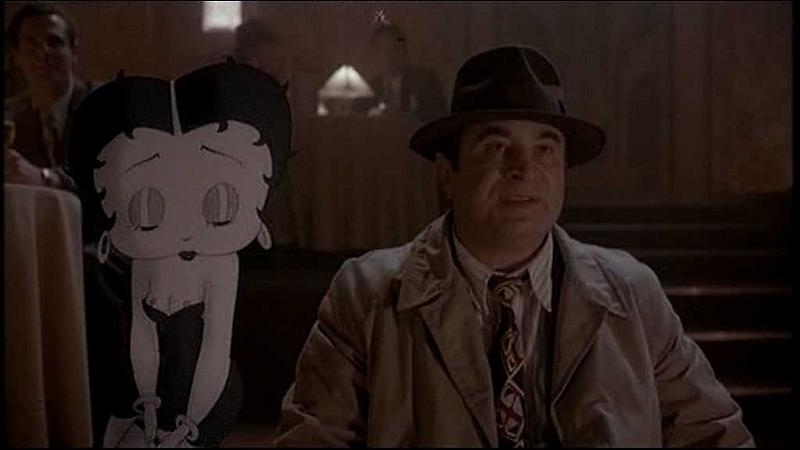
Apparently, in the theatrical version of Who Framed Roger Rabbit, Jessica revealed a little too much during her car accident, Betty Boop (voiced by legendary Mae Questel) went topless trying to adjust her stockings, and Baby Herman put his finger exactly where you’d expect he would. All of these were digitally altered subsequently.

Betty Boob
Obviously, the film rights to the non-Disney characters were negotiated with more ease with Steven Spielberg on board as producer, still, some scenes were planned with Superman, Popeye, Tom & Jerry, Casper, etc. and ultimately dropped for legal issues mostly. Look for some characters that did not make the final cut on the special edition DVD.

More importantly, an entire sequence was deleted from the feature to keep the pace of the story going, even though a brief moment of it appears in the trailer. Ironically the first completed animated sequence was in that scene, a parody of the shower scene in Alfred Hitchcock’s Psycho.

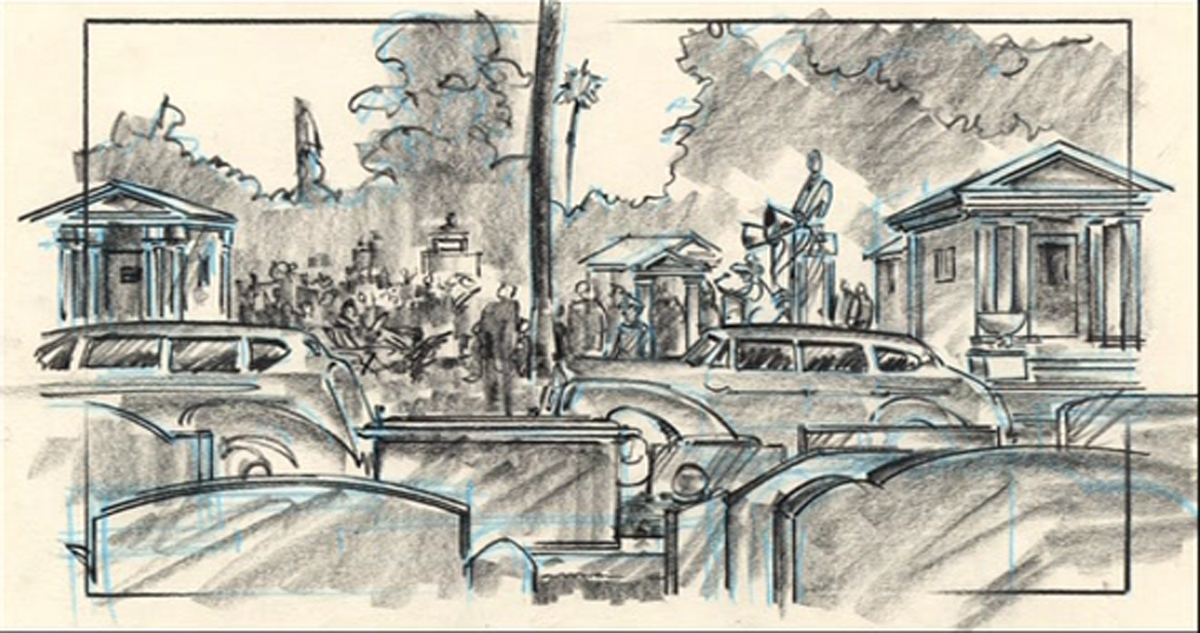
Storyboard of Marvin Acme's funeral
Known as “The pig head sequence”, it was supposed to take place right after Eddie frees himself from the handcuffs. He then attends Marvin Acme's funeral, and later sneaks back into the ink-and-paint club where he gets caught by Judge Doom while trying to snoop. He is taken into Toontown by the weasels where he gets “toon-a-rooned” (a giant toon pig head is stuck to his own head) as a punishment. He runs back home, gets a turpentine shower to erase the head which falls down the drain (that’s the shot I meant earlier).
The following scene where Eddie gets out of the bathroom to find Jessica Rabbit is in his living room is included in the final cut, but to justify Eddie’s visit to the bathroom, the sound of a toilet flushing was added to the mix.

The scene (minus the funeral, apparently never filmed) is included in the bonus features of the special edition DVD. The animation, sound effects and music were apparently completed. The DVD also includes rough animation and raw footage without the animation, which gives you a glimpse of how the special effects were created: Bob Hoskins wore a metal armature on his head onto which the head of the pig was later drawn.

Interestingly enough, Jessica Rabbit was modeled mainly after none other that Veronica Lake, a perfect movie icon from the 1940s which I wrote about in a previous article. To make her figure even more special that it already was, they designed it so that, when she walked, her bosom would move up when a normal woman's would move down and vice and versa.


Finally, did you know that the toon shoe sacrificed by judge doom to demonstrate the use of the dip is voiced by none other that Bart Simpson's voice talent Nancy Cartwright the year before the Simpsons first aired.
Don't forget to hit "like" on the Facebook page!
That's all for today folks!
Read More
Posted in Alfred Hitchcock, Bart Simpson, Betty Boop, Bob Hoskins, Mae Questel, Nancy Cartwright, Psycho, Robert Zemeckis, Steven Spielberg, The Simpsons, Veronica Lake, Walt Disney, Who Framed Roger Rabbit | No comments

Wednesday, 1 August 2012

A Star Is Born Again

Posted on 12:29 by john mical

I mentioned a restoration technique that I thought was interesting when I discussed Frank Capra’s Lost Horizon. A complete soundtrack was still extant but whole chunks of footage were missing. Instead of discarding the soundtrack, the restoration team opted to replace the missing parts with appropriately placed still pictures.


Mason in costume
When the time came to restore A Star Is Born, a similar problem occurred. Even before the film’s premiere, many scenes were removed to tighten an already long story. Scenes of Norman Maine shooting a pirate film on location are now only remembered through a few stills.


Mason in a pre-premiere outtake
But this can be considered part of the making of the film. However, soon after the premiere, Warner Brothers decided that the film was too long and an intermission was inappropriate. So under the pressure of local distributors (who wanted a shorter film to allow more showings per day) the film was heavily butchered in several places without the assistance of director George Cukor. Since the idea was to shorten the film only through editing, no reshoots were planned to explain missing plot points or to sweeten awkward transitions.


Deleted picnic scene
That meant that once it was decided that the first scene of Norman Maine’s extensive search for Esther was gone, the rest of the scenes had to go too. And indeed it did, along with two musical numbers (when there weren’t that many to begin with) and many other scenes.

The restoration began when the complete monaural copy of the soundtrack was located in the vaults of Warner Brothers. This gave the restorers the hope that, if the missing footage could be located, the world could once again see the original edit of the film. Their goal was to show it to George Cukor who could never sit through the film again.
At the time the decision to cut the film was made, Warner requested the cuts of the copies already in circulation to be shipped back to the studio. It soon became apparent that they had not only tossed away these cuts, but had also cut the original negative and thrown away the outtakes.
With apparently nothing to work with, they went on an extensive search for uncut copies. Except for the missing musical sequences that they got from the vaults of the studio or from a private collector who had stolen the “Long Face” sequence long ago, the all important dramatic scenes of the first third of the film could not be located in their entirety. The decision was taken to use the bits of film found in the department that stored stock footage (the bits and pieces that were considered usable for other films like streets, cars, locations, etc.) and the studio stills over the soundtrack in place of the cut scenes.

The main problem with this was the fact that, to save on costs, and unlike the regular studio practice of the time, very few studio stills were taken on this production (one only per scene average). So they sometimes had to recreate a still by combining several unrelated ones or by completely photographing new scenes (The tenant of the Oleander Arms is an actress from the eighties).
In spite of that, two dialog-heavy scenes still had to be shortened for the restoration, the complete version of which are offered as bonus features on the Blu-ray.
However, the result looks marvelous and even though the appearance of the stills intercut with live footage can seem weird to some, it does help to raise awareness to film preservation. Unfortunately George Cukor died before this restoration was completed and screened.
As a matter of fact, according to this article, at least one complete copy of the film (and even some scenes cut prior to release) still exist in the hands of a private collector named Michael Arick, which seems believable enough considering how the "Long Face" sequence was recovered. However, due to a conflict about a previous collaboration with Warner over a complete print of A Streetcar named desire (among other things), Arick does not wish to deal with them again. Let's pray that the film will some day be complete.
Early concept for The Man That got Away
The Blu-ray also offers other versions of the very famous Man That Got Away sequence, because it was filmed to playback several times before everyone involved was satisfied with costumes, lights and the overall look of it.
Early concept for The Man That got Away
I strongly suggest you to buy the soundtrack CD if you like the film. After all, it IS a musical. Also, a great book called “A star is born, The making of the 1954 movie and its 1983 restoration” was written by Ronald Haver, who is responsible for this restoration. The first part tells the fascinating story of the film at the time of the making which helps to explain the decisions made at the time regarding its fate (it was the first Warner Cinemascope picture), and the second part is about the epic restoration.
Don’t forget to like the Facebook page!
That’s all for today folks!
Read More
Posted in A Star Is Born, A Streetcar Named Desire, Cinemascope, Frank Capra, George Cukor, James Mason, Judy Garland, Lost Horizon, Michael Arick, Ronald Haver, Warner Brothers | No comments

Friday, 20 July 2012

Rope

Posted on 14:30 by john mical
Alfred Hitchcock's Rope will be released on Blu-ray in September, along with many other classics owned by Universal.
Of course, any cuts on this film had to be made before shooting in the script itself. And the topic made it the ideal target of censors: the movie was about "it". "It", being a very respectable way of meaning homosexuality. So the adaptation removed the very British (but also very ambiguous) use of the word "dear" spoken between men, and various other things. 
I'm eager to see the results of the re-mastering. I remember a time when we were lucky if a film had not been tampered with when released on home video.
I found an old British VHS tape of Rope. You'd think since the film is shot in long continuous takes, there was no way they could change anything.
Yet, not only is the opening Warner Brothers logo is also replaced by Universal's, but David Buttolph's arrangements of Francis Poulenc's "Mouvement perpétuel" are drowned into a different arrangement! You can still hear the original music under the overdubbing. Presumably, this was done to achieve a stereo effect during the very few moments where there was music.
 Here is the opening title in this version:

 And here is the end title:

For comparison, here is the film on youtube:

And the awesome especially filmed trailer which takes place before the film:


That's all for today folks!
Read More
Posted in Alfred Hitchcock, David Buttolph, Francis Poulenc, James Stewart, Rope, Universal, Warner Brothers | No comments

Wednesday, 4 July 2012

Lost And Rare Films

Posted on 05:14 by john mical

Today, I’d like to share an awesome video release, in keeping with the topic of my blog. I already covered lost television episodes in my article about the Avengers. Now, from Festival Films come the first volumes in a series of DVDs called “Lost and Rare”.


And volume 1 contains exactly that! Rare episodes, films, pilots. Some are seen here for the first time since they first aired, and others… have never been seen at all.


So here is your chance of seeing lost and rediscovered footage of Hollywood stars as if you were a sponsor, deciding if the pilot is going to series. Singer – dancer Jane Powell opens the ball with The Jane Powell Show. A 32 minute sitcom so rare that even the Imdb had no record of it before I submitted an entry. As a matter of fact, don’t waste your time looking for info on the internet. You won’t find much.


And yet, this pilot was full of promise. Miss Powell (of Royal Wedding fame) stars as K.C. McKay, a famous singer who quits her job to become the housewife of a suburban college professor. Of course, adapting to campus life will not be easy; especially considering how prejudiced the other professors are against show-business, and how her impresario pressures her to return to work. The part is played by Elliott Reid (Jane Russell’s boyfriend in Gentlemen Prefer Blondes).

The pilot never developed into a series, however, Russell Johnson who plays the husband, went on to star in Gilligan's Island as another professor.
Canine star Munroe
Verna Felton fighting a lion
Next, animal-lovers are in for a treat with a Rintintin-like adventure called Munroe. Watch out for Verna Felton in one of her last roles as the mother-in-law. You may not know her face, but you‘ve heard her voice for sure as the Queen of Hearts in Alice in Wonderland, the fairy godmother in Cinderella, Aunt Sarah in Lady and The Tramp, Flora in Sleeping Beauty or an Elephant in The Jungle Book and Dumbo. Another Disney regular and awesome character actor appearing here is John Fiedler as the cook. He is the kind of character actor who seemed to appear in every TV show in town at least once. He was also the voice of Piglet.
A Margaret O’Brien vehicle is also included (inventively called “Maggie”). Remember little Tootie from Meet Me In St Louis? Well, she grew up. And she is a lot for her parents to handle. As a matter of fact, her screen dad in both films is the same one: Leon Ames. You may remember her mother Fay Baker in a little part as a party girl in Alfred Hitchcock’s Notorious; and her neighbor Jesslyn Fax as Miss Hearing Aid in Rear Window by the same director.
The irony of this volume is that the only pilot that spurred a successful series on this set, was not a pilot at all. Meet McGraw was intended to be just another episode of Four Star Playhouse. It is presented here complete with commercials. Look out for Ellen Corby, the hotel manager in Alfred Hitchcock's Vertigo, in a lengthier part.
And the icing on the cake is the pilot for the second “Ed Wynn Show”. This actor is a fascinating and lovable character: you may remember him in Disney productions like Alice in Wonderland as the mad hatter, That Darn Cat, Son of Flubber or as uncle Albert in Mary Poppins. I strongly suggest you watch The Twilight Zone’s second episode “One for the Angel” where this amazing actor displays his enormous talent. Here he plays a somewhat similar role as a kind of guardian angel not only to his two grand daughters but also to a group of college kids.
An exclusive footage of Ed Wynn talking to the sponsor is included after the show.


Volume 2 of the collection focuses on sports.
In only 10 minutes, the first newsreel “Sports Immortal” offers a 1939 montage of older footage from many sports champions (one of whom is the horse Man O’ War) who remain famous to this day. There is even a rare glimpse at a very young ice-skater Sonja Henie before she started her film career.
Joe DiMaggio
Baseball fans will love Touching All Bases! Actual legends are captured here on film (Like Marilyn Monroe's husband Joe Die Maggio) and should you want to emulate them, they are giving you instructions (with slow motion and all) for your game.
Also from 1939, The Brown Bomber will show you that Entertainment Tonight invented nothing. The camera follows heavy weight champion Joe Louis as a groupie would in his training, his breakfast, his listening to records, etc. 
Kings of Sport is a newsreel featuring champions of the forties like Babe Ruth, Jesse Owens, or golfer Bobby Jones.
To wrap up these volume is a piece of History! Adolf Hitler himself appears in an American newsreel about the 1936 Olympic Highlights. It is fascinating to have an American point of view over the Nazi-themed event so famously covered by German film-maker Leni Riefenstahl.


Find out more about this set and upcoming releases from the official site, the youtube channel, and of course buy volume 1 and volume 2 on amazon !

That's all for today folks!
Read More
Posted in Alfred Hitchcock, baseball, Ed Wynn, Festival Film, Jane Powell, Jane Powell Show, Joe DiMaggio, Lost And Rare, Margaret O'Brien, Marilyn Monroe, Meet McGraw, Munroe, Notorious, Sports Immortals, Verna Felton | No comments

Tuesday, 26 June 2012

Alice Guy, the woman's touch

Posted on 07:00 by john mical

Directors often are men. I mentioned Dorothy Arzner a few months ago. Her position in Hollywood is rather unique. Ida Lupino also directed films but she was primarily famous for her career as an actress, which is how she began anyway.


Did you know that one of the first internationally successful directors of Cinema History happens to be a woman?


Before the D.W. Griffith, before Cecil B. DeMille, there was a woman who, amazingly enough, started as a simple secretary for Mr. Gaumont and became the first woman film director.

Her name was Alice Guy. She directed her first film some time between 1896 or 1902 but her last was made in 1920. In that time, she developed the use of special effects, color, sound, etc. More importantly, she made the medium evolve from just shooting an unrehearsed street scene for a minute or two, to filming a fiction film of feature length.
The confusion concerning the start of her career comes from the fact that she claimed it started in 1996 although the film she mentions as her first was identified as from 1902.

Alice on the set of her first film in 1902
She remembered her first film to be a short subject about a “cabbage fairy” who made babies appear in a garden. Until recently, it was naturally assumed that this film was “The cabbage fairy”, directed earlier in 1900 by some unknown director, but a closer inspection of Gaumont films enabled to identify the film as Birth of the Children, later retitled Midwife to the upper classes, with a similar subject. The confusion was easy: the subject is roughly the same, but the sign on the seller’s shop clearly says “The cabbage fairy”, which title Alice Guy preferred anyway (It may have been a working title). The picture on the left was taken after the filming as a souvenir, Alice Guy jokingly wore the unknown actor's clothes so she could appear between her two friends and actresses: Germaine and Yvonne Serand who were sisters. Here is the film:


25 years before the success of The Jazz Singer, she also made more than 400 sound films as early as 1902 with a process called chronophone. They were usually just one continuous shot of someone singing or dancing. In this rare behind the scene shot from January 9, 1907, Alice is seen directing The Capulets's Ball from Romeo and Juliet (Catalog number 300), assisted by Etienne Arnaud who is wearing sunglasses to shield his eyes from the intense lighting.


More ambitious projects came her way: in 1906, she directed a 33 minute epic called The Birth, The Life and The Death of Christ. Although primitive to a modern audience (the film is basically a succession of wide angle scenes in the tradition of the theater), it was nevertheless a definite breakthrough for the time with elaborate sets and costumes, animals and hundreds of extras.


Alice Guy directing Bessie Love
Soon after her marriage with an English director named Herbert Blaché, she moved to the USA to work with American stars of the time like Bessie Love, Olga Petrova; and for William Randolph Hearst among others. She even created her own film studio (Solax) in New Jersey. Unfortunately, she moved back to France after her divorce and gave up the film industry. Although she directed hundreds of films (among which many are lost even though she tried herself to find copies later) and eventually got some recognition (she was awarded the legion of honor late in her life), she is mostly forgotten like many other pioneers of cinema.
More Pictures on the Facebook page! Hit the like button!

That’s all for today folks!
Read More
Posted in Alice Guy, Alice Guy Blaché, Bessie Love, chronophone, Dorothy Arzner, Herbert Blaché, Ida Lupino, Midwife to the upper classes, The cabbage fairy, William Randolph Hearst | No comments

Saturday, 9 June 2012

Lost Hair

Posted on 05:14 by john mical


In my article about Leslie Caron, I briefly mentioned her An American In Paris co-star’s habit of wearing a cap to hide his bald scalp: Gene Kelly almost never appeared without a wig or a cap. But there are a few pictures out there of him going “natural”.

Some other actors also lost their hair at a relatively young age. For most of them, it was a well kept secret outside of the industry. Others occasionally appeared without their toupee in public.
John Wayne even once joked about the fact that his hair was real, not his, but real. He appears on this picture signing autographs for soldiers. The war is indeed a time when stars often stop bothering about “trifling” matters like their appearance. During most of World War II, Fred Astaire gladly got rid of his wig, which he didn’t like much. The latter was designed with a visible receding hairline anyway.
Bing Crosby wore a similar kind of prosthesis and you can see him without it on this picture.
Other stars in the same condition include Frank Sinatra, James Stewart, Tony Curtis,…
Even though Sean Connery set the trend for a more natural look, to this day, actors like John Travolta show their scalp only on stolen paparazzi pictures.
 Women, of course, rarely encounter the same problem. However, filmmakers can be very demanding with their actresses. Vera Miles, among others, had to shave her head for the filming of 5 Branded Women. Consequently, she had to wear a wig for her next film and most famous role: Lila Crane in Alfred Hitchcock’s Psycho.
But there is another area where women tend to use artificial hairs.
Lana Turner
It will come as no surprise to you if I tell you that Mae West or Jean Harlow had shaved their eyebrows which they used to replace by a stylized and quite unrealistic stroke of makeup pencil. In those days, it was all the rage.
Most stars of the 1940s and 1950s who started as starlets in those days did the very same thing. Trends changed later and actresses like Ingrid Bergman launched a more natural look that was soon adopted by all.

Unfortunately, you may not know that once shaved, eyebrows do not always grow back. The most famous story is that of Lana Turner who, in one of her early screen roles in The Adventures of Marco Polo, not only had to wear a very uncomfortable wig, but also had to shave her eyebrows, as producer Samuel Goldwyn insisted. For the rest of her life, she had to design her eyebrows with makeup.
and in 1938 in Marco Polo
Turner in 1937 (They Won't Forget)


A not so renown story is that of Judy Garland. Makeup artist Del Armstrong, who worked with both ladies, remembered : "With Judy, there was one problem - it was the same problem Lana had - no eyebrows. Because in the early days of glamor, they used to tweeze them quite a bit so they could make exaggerated shapes, and if you tweeze your eyebrows too much, then they just don't grow back. So I had some hair lace, like for a mustache or wigs, and I had some eyebrows made for Judy for this picture (A Star Is Born). You couldn't just pencil them in, because there's no dimension. A pencil is flat. Penciling is fine for a still picture, but for a motion picture, people are turning their heads and you can see that it's flat. So I put these eyebrows on Judy."

More pictures on the Facebook page. Please click "like" to receive updates!

That's all for today folks!
Read More
Posted in bald, Bing Crosby, Fred Astaire, Gene Kelly, hair, hairpiece, Jean Harlow, John Travolta, John Wayne, Judy Garland, Lana Turner, Psycho, Sean Connery, Vera Miles, wig | No comments
Newer Posts Older Posts Home
Subscribe to: Posts (Atom)

Popular Posts

  • The Lost World
    Arthur Conan Doyle's most famous work is the creation of detective Sherlock Holmes, and indeed the first screen adaptation came in 1900....
  • Paulette Rollin, Sweet Nightingale
    Today is Paulette Rollin's birthday.  She was the French singing voice voice of Walt Disney 's Cinderella when it was first release...
  • The Fortune Teller
    Lili Damita and Georges Melchior Last month, actor Paul Walker died before he could complete filming of Fast & Furious 7 . Yet Universal...
  • Snow White's first French version
    Early this February, I've lived a very moving experience : the projection of a very rare copy of the first 1938 dub of Walt Disney '...
  • Gaslight
    Gaslight or When cinema tries to destroy itself . Patrick Hamilton is a brilliant British play-write who penned among other things Rope...
  • Fantasia
    When he made Fantasia , Walt Disney originally thought of it as a concert feature (that was the original title) which would change over tim...
  • Journey To The Center Of The Earth
    Do you remember Disney ’s 20,000 Leagues Under The Sea ? Paul Smith ’s score was just released on CD after being only available as an Itune...
  • King Kong
    Any fan of King Kong knows that before Peter Jackson 's CG monkey, long before Jessica Lange showed her boobs in John Guillermin '...
  • Sodom & Gomorrah (4) Special Effects
    I'm going to write some more about Sodom & Gomorrah (see my previous posts about the film ) and I will concentrate on the special ...
  • Elephant Walk
    Vivien Leigh, more than ten years after her success as Scarlett O’Hara, had proven that she was still hot by winning a second academy award ...

Categories

  • 20th Century Fox
  • A Family Story
  • A Star Is Born
  • A Streetcar Named Desire
  • Adrian Knight
  • Adriana Caselotti
  • Adrienne D'Ambricourt
  • Albert Capellani
  • Alene Dahl
  • Alfred Abel
  • Alfred Fatio
  • Alfred Hitchcock
  • Alfred Newman
  • Alice Guy
  • Alice Guy Blaché
  • Alida Valli
  • All About Eve
  • Allan Forrest
  • An American In Paris
  • André Berthomieu
  • André Chéron
  • André Daven
  • André Hugon
  • Andreas Deja
  • Angel Sreet
  • Angela Lansbury
  • Anick Faris
  • Ann Todd
  • Anna and the King of Siam
  • Anne of Green Gables
  • Anne Shirley
  • Annie Get Your Gun
  • Anouk Aimée
  • Anthony Perkins
  • Antonella Lualdi
  • Arthur Freed
  • Baby Face
  • bald
  • Bambi
  • Barbara Stanwyck
  • Bart Simpson
  • baseball
  • Beauty and the Beast
  • Bela Lugosi
  • Bella Darvi
  • Ben Hur
  • Bernard Deyriès
  • Bernard Herrmann
  • Bessie Love
  • Bette Davis
  • Betty Balfour
  • Betty Blythe
  • Betty Boop
  • Betty Compson
  • Betty Hutton
  • Betty Noyes
  • Betty White
  • Beyond The Rocks
  • BFI
  • Billy Eckstine
  • Bing Crosby
  • Blackmail
  • Bloopers
  • Bob Hope
  • Bob Hoskins
  • Bobby Driscoll
  • Bourvil
  • Boxing
  • Bram Stoker
  • Breakdowns
  • Brigitte Helm
  • Bruce Cabot
  • Bruno Alexiu
  • Buddy Ebsen
  • Bulldog Drummond
  • Capucine
  • Carl Boese
  • Carlos Villarias
  • Carmen
  • Cary Grant
  • cast replacement
  • Cecil B. DeMille
  • Cecilia Bach
  • Cendrillon
  • censorship
  • Champagne
  • Charles Boyer
  • Charles Chaplin
  • Charles de Rochefort
  • Charles Laughton
  • Charlotte Shelby
  • Charlton Heston
  • Chris Fujiwara
  • Christiane Tourneur
  • Christmas
  • chronophone
  • Cinderella
  • Cinemascope
  • Citizen Kane
  • Claude Gensac
  • Claudette Colbert
  • Cleopatra
  • Clive Brook
  • Colin Firth
  • Columbia
  • Confidential
  • Constance Talmadge
  • Corey Burton
  • Creighton Hale
  • Cruel Intentions
  • Cyd Charisse
  • Dana Andrews
  • Dangerous Liaisons
  • Dangerous Love Affairs
  • Dany Robin
  • Dark City
  • Darryl F. Zanuck
  • David Buttolph
  • David Charvet
  • David Niven
  • David O. Selznick
  • Dean Martin
  • Debbie Reynolds
  • Deems Taylor
  • Denny Crockett
  • Diana Rigg
  • Diana Wynyard
  • Diane Baker
  • Die drei Portiermädel
  • Dimitri Tiomkin
  • dinosaurs
  • Dionne Warwick
  • Dominique Monfery
  • Don Quixote
  • Don't Bother To Knock
  • Dora Luz
  • Doris Day
  • Dorothy Arzner
  • Douglas Fairbanks
  • Dracula
  • Dumbo
  • Earl Hayes
  • Eartha Kitt
  • East Lynne
  • Ed Wynn
  • Edward Van Sloan
  • Elephant Walk
  • Elinor Glyn
  • Elizabeth Taylor
  • Elliot Forbes
  • Elliott Reid
  • Elmer Berstein
  • Elmo Lincoln
  • Empire of the Sun
  • Enid Markey
  • Errol Flynn
  • Ethel Barrymore
  • Evergreen
  • F.W. Murnau
  • Fantasia
  • Fantasia 2000
  • Fay Wray
  • Fernand Charpin
  • Festival Film
  • Festival Films
  • film program
  • first dub
  • First National Pictures
  • Floyd Huddleston
  • foreign dubbing
  • foreign dubs
  • forgotten title
  • Fort Lee
  • Fox Film Corporation
  • France
  • Francis Poulenc
  • François Fratellini
  • François Rozet
  • Frank Capra
  • Frank Merrill
  • Frankenstein
  • Franz Waxman
  • Frau Lehmanns Töchter
  • Freaks
  • Fred Astaire
  • French Revolution
  • French version
  • Frenzy
  • Fritz Lang
  • Fritz Leiber
  • Fritz Rasp
  • Fun and Fancy Free
  • Gaslight
  • Gene Kelly
  • Gene Tierney
  • Gentlemen Prefer Blondes
  • George Archainbaud
  • George Arliss
  • George Cukor
  • George Siegmann
  • Georges Delerue
  • Gigi
  • Gina Lollobridgida
  • Glenn Close
  • Gloria Swanson
  • Goldfinger
  • Golf
  • Gone With The Wind
  • Gottfried Huppertz
  • Gower Champion
  • Graham Cutts
  • Grant Bardsley
  • Gregg Toland
  • Gregory Peck
  • Greta Garbo
  • Groucho Marx
  • Gustaf Tenggren
  • Gustav Fröhlich
  • hair
  • hairpiece
  • Hall Wallis
  • Hammer
  • Hanni Weisse
  • Harold Arlen
  • Harry Baur
  • Harry F. Millarde
  • Harry Hilliard
  • Hattie McDaniel
  • Hedda Hopper
  • Helen Kane
  • Henri de la Falaise de la Coudraye
  • Henri Mancini
  • Henri Rollan
  • Henri-Georges Clouzot
  • Henrich Gorge
  • Henry Krauss
  • Herbert Blaché
  • High School Musical
  • Holiday
  • Howard Blake
  • Howard Hughes
  • Humphrey Bogart
  • I Married A Witch
  • Ida Lupino
  • Ike Egan
  • Ilene Woods
  • Inferno
  • Ingrid Bergman
  • Irenne Dunne
  • Irwin Kostal
  • Ivor Montague
  • Ivor Novello
  • J. Gordon Edwards
  • Jack Cardiff
  • Jack Haley
  • Jack Hawkins
  • Jacques Tati
  • Jacques Tourneur
  • James Baskett
  • James Bond
  • James C. McKay
  • James Hilton
  • James Katz
  • James Mason
  • James Stewart
  • Jane Powell
  • Jane Powell Show
  • Jane Russell
  • Jane Seymour
  • Jane Wyman
  • Janis Paige
  • Jayne Mansfield
  • Jean Chalopin
  • Jean Cocteau
  • Jean de Briac
  • Jean Hagen
  • Jean Harlow
  • Jean Renoir
  • Jean Rochefort
  • Jean Toulout
  • Jeanne Moreau
  • Jeffrey Katzenberg
  • Jerry Mathers
  • Jesse Lasky
  • Jesse Owens
  • Jessie Matthews
  • Joe DiMaggio
  • Joe Hale
  • John Addison
  • John Barrymore
  • John Debney
  • John Farrow
  • John Hench
  • John Hurt
  • John Huston
  • John Travolta
  • John Wayne
  • Johnny Depp
  • Johnny Weissmuller
  • Joop van Liempd
  • Joseph Breen
  • Josette Day
  • Jour De Fête
  • Journey To The Center of the Earth
  • Judy Garland
  • Julie Andrews
  • Julien Carette
  • Juliet Shelby
  • June Caprice
  • June Carlson
  • Ken Adam
  • Kevin Brownlow
  • Kid Roberts
  • Kim Novak
  • King Kong
  • Kroger Babb
  • L'Enfer
  • Lady And The Tramp
  • Lana Turner
  • Larry Semon
  • Laurel and Hardy
  • Lauren Bacall
  • Laurence Olivier
  • Laurent Bouzereau
  • Laurie Johnson
  • Le cœur sur la main
  • Le corsaire
  • Leon Abrams
  • Léonce Perret
  • Leopold Stokowski
  • Les filles de la Concierge
  • Les Liaisons dangereuses
  • Leslie Caron
  • Lewis Stone
  • Lex Karsemeyer
  • Life and Laughter
  • Lifeboat
  • Lili Damita
  • Lilian Gish
  • Lizabeth Scott
  • Lloyd Hughes
  • Lon Chaney
  • London After Midnight
  • Lost And Rare
  • Lost Horizon
  • Lost in la Mancha
  • Lotte Reiniger
  • Louella Parsons
  • Louis Calhern
  • Louis Gasnier
  • Louis Hightower
  • Louis Jourdan
  • Louis Jouvet
  • Louis Mercanton
  • Louis Mercier
  • Louis Prima
  • Louise Lorraine
  • Love
  • Luana Patten
  • Lucie Dolène
  • Madame Du Barry
  • Madame Sans-Gêne
  • Mae Questel
  • Make Mine Music
  • Marc Allégret
  • Marcel Achard
  • Marcel Pagnol
  • Margaret Nolan
  • Margaret O'Brien
  • Margaret Shelby
  • Margareta-Maria Langen
  • Margarete Kupfer
  • Marge Belcher
  • Marge Champion
  • Margie Bell
  • Marguerite Clark
  • Marie Antoinette
  • Marilyn Monroe
  • Marjorie Belcher
  • Mark Of The Vampire
  • Mark Shaiman
  • Marlene Dietrich
  • Marnie
  • Mary Miles Minter
  • Mary Osborne
  • Mary Pickford
  • Matt Berman
  • Maureen O'Hara
  • Maureen O'Sullivan
  • Maurice Binder
  • Maurice Chevalier
  • Maurice Schutz
  • Maurice Tourneur
  • Max Steiner
  • Meet McGraw
  • Melody Time
  • Metropolis
  • MGM
  • Michael Arick
  • Michael Balcon
  • Michael Wilding
  • Michèle Alfa
  • Michelle Pfeiffer
  • Mickey and the Beanstalk
  • Mickey Mouse
  • Midwife to the upper classes
  • Miklos Rozsa
  • Miklós Rózsa
  • Mom And Dad
  • Monogram
  • Monte Carlo
  • Muir Mathieson
  • Munroe
  • Murder She Wrote
  • My Fair Lady
  • Nancy Adams
  • Nancy Cartwright
  • Nat King Cole
  • Nita Naldi
  • Noam Kaniel
  • Nobuyoshi Koshibe
  • North By Northwest
  • Nosferatu
  • Notorious
  • nude
  • nudity
  • Oliver Hardy
  • Orane Demazis
  • Orson Welles
  • Otis Harlan
  • outtake
  • Pâquerette
  • Paramount
  • Pat Boone
  • Pat Moore
  • Pathé
  • Patrick Hamilton
  • Patrick Macnee
  • Paul Huf
  • Paul Newman
  • Paulette Rollin
  • Pearl White
  • Peter Finch
  • Peter Jackson
  • Peter Pan
  • Phil Harris
  • Philip Glass
  • Pier Angeli
  • Pierre Blanchar
  • Pinocchio
  • Prayer to the Stars
  • Psycho
  • Queen of Sheba
  • Ray Bolger
  • Ray Harryhausen
  • Raymond Agnel
  • Rebecca
  • Reginald Denny
  • René Borg
  • Renée Héribel
  • Richard Addinsell
  • Richard Thorpe
  • RKO
  • Robert Aldrich
  • Robert Harris
  • Robert Harrison
  • Robert Newton
  • Robert Zemeckis
  • Robin Hood
  • Roger Allers
  • Romeo And Juliet
  • Romy Schneider
  • Ron Goodwin
  • Ronald Colman
  • Ronald Haver
  • Rope
  • Roscoe Fatty Arbuckle
  • Rossana Podestà
  • Roy Atwell
  • Roy Disney
  • Roy Webb
  • Rudolf Klein-Rogge
  • Rudolph Valentino
  • Rupert Everett
  • Ryan Phillippe
  • Sacha Guitry
  • Salvador Dalí
  • Sam Wood
  • Sarah Bernhardt
  • Sarah Michelle Gellar
  • Scilla Gabel
  • Sean Connery
  • Serge Bromberg
  • Serge Reggiani
  • serial
  • Shelby Flint
  • Shuki Levy
  • Silk Stockings
  • Simon Baker
  • Singin' In The Rain
  • Sleeping Beauty
  • Sneeuwwitje en de zeven dwergen
  • Snow White And The Seven Dwarfs
  • Sodom And Gomorrha
  • Something's Got To Give
  • Song Of The South
  • Spellbound
  • Sports Immortals
  • Squibs
  • Stage Fright
  • Stan Laurel
  • Stanley Baker
  • Stanley Donen
  • Stellan Windrow
  • Steven Spielberg
  • Stewart Granger
  • Sting
  • Studio Pierrot
  • Sullivan's Travels
  • Sunflower
  • Susan Sheridan
  • Tab Hunter
  • Taiyo no ko Esteban
  • talkie
  • talking picture
  • Tarzan
  • Tarzan Escapes
  • Tarzan of the Apes
  • Terry Gilliam
  • Thanhouser Film Corporation
  • That Wonderful Urge
  • The Adventures of Prince Achmed
  • The Adventures of Robin Hood
  • The Adventures of Tarzan
  • The Avengers
  • The Bat Whispers
  • The Big Day
  • The Black Cauldron
  • The cabbage fairy
  • The Capture Of Tarzan
  • The Corsair
  • The Egyptian
  • The Eighth Wonder of the World
  • The Emperor's New Groove
  • The Exploits Of Elaine
  • The Fortune-Teller
  • The Ghost of Slumber Mountain
  • The Greatest Show On Earth
  • The Janitor's daughters
  • The Jazz Singer
  • The Jungle Book
  • The Leather Pushers
  • The Lion King
  • The Lodger
  • The Lodger a Story of the London Fog
  • The Lost World
  • The Mountain Eagle
  • The Mysterious Cities Of Gold
  • The Paradine Case
  • The Perils of Pauline
  • The Phantom Fiend
  • The Phantom of the Opera
  • The Pleasure Garden
  • The Rescuers
  • The Robe
  • The Romance of Tarzan
  • The Simpsons
  • The Story of William Tell
  • The Strange Love Of Martha Ivers
  • The Sweatbox
  • The Ten Commandments
  • The Three Masks
  • The White Shadow
  • The Wizard of Oz
  • Thea von Harbou
  • Theda Bara
  • These Amazing Shadows
  • This Gun For Hire
  • Thomas Mitchell
  • Three Ages
  • Three Little Words
  • Thunderball
  • Tilly Prein-Bouwmeester
  • Tod Browning
  • Tom Jones
  • Tommy Noonan
  • Toni Seven
  • Topaz
  • Torn Curtain
  • Ulysses 31
  • Under Capricorn
  • United Artists
  • Universal
  • Valmont
  • Vera Miles
  • Verna Felton
  • Veronica Lake
  • Vertigo
  • Victor Fleming
  • Victor Saville
  • Vistavision
  • Vivien Leigh
  • W.C. Fields
  • Wallace Beery
  • Walt Disney
  • Warner Brothers
  • Warren Beatty
  • Who Framed Roger Rabbit
  • wig
  • William Beaudine
  • William Desmond Taylor
  • William Dieterle
  • William Haines
  • William Randolph Hearst
  • Willis O'Brien
  • Woman To Woman
  • WWII
  • 宇宙伝説ユリシーズ 31

Blog Archive

  • ▼  2014 (11)
    • ▼  August (1)
      • The Lost World
    • ►  July (1)
    • ►  June (1)
    • ►  April (2)
    • ►  March (2)
    • ►  February (2)
    • ►  January (2)
  • ►  2013 (21)
    • ►  December (2)
    • ►  November (2)
    • ►  October (2)
    • ►  September (1)
    • ►  August (1)
    • ►  July (2)
    • ►  June (1)
    • ►  May (2)
    • ►  April (1)
    • ►  March (1)
    • ►  February (2)
    • ►  January (4)
  • ►  2012 (32)
    • ►  December (2)
    • ►  November (4)
    • ►  October (3)
    • ►  September (3)
    • ►  August (3)
    • ►  July (2)
    • ►  June (2)
    • ►  May (4)
    • ►  April (2)
    • ►  March (2)
    • ►  February (3)
    • ►  January (2)
  • ►  2011 (34)
    • ►  December (3)
    • ►  November (2)
    • ►  October (5)
    • ►  September (4)
    • ►  August (5)
    • ►  July (5)
    • ►  June (7)
    • ►  May (3)
Powered by Blogger.

About Me

john mical
View my complete profile